

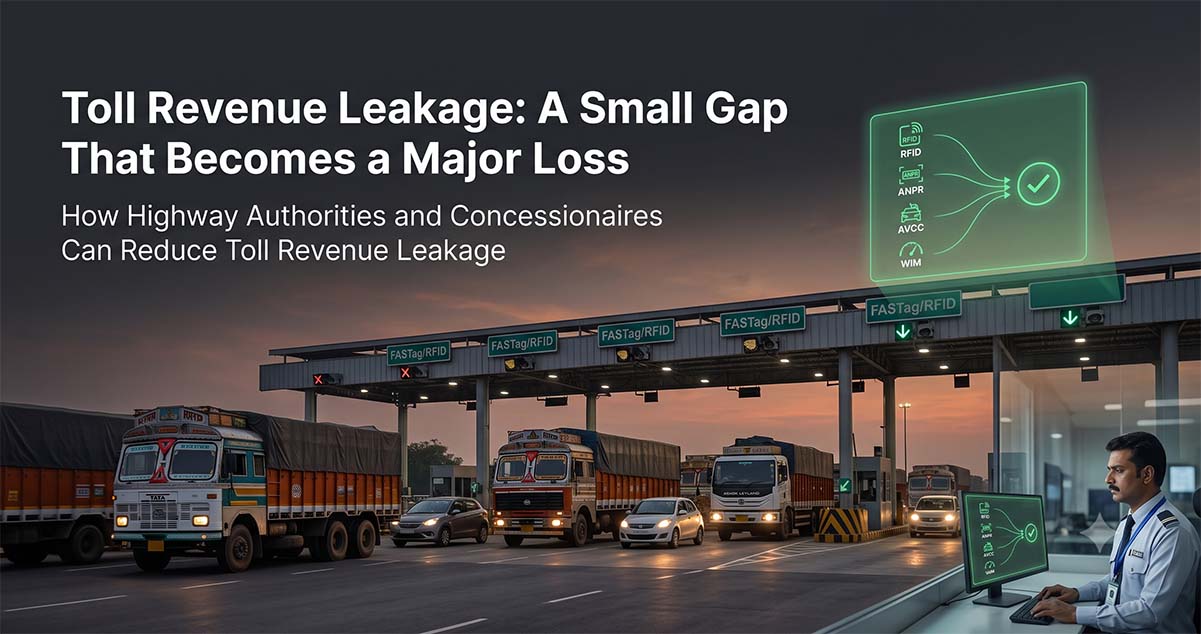
Toll Revenue Leakage: A Small Gap That Becomes a Major Loss
Toll revenue leakage is the gap between the toll an operator should collect based on actual traffic and the amount that is finally recorded and recovered. It often begins with small operational exceptions: an incorrectly classified vehicle, an unread FASTag, an unmatched number plate, an unresolved violation or delayed reconciliation. Across thousands of daily transactions, these exceptions can become a significant and recurring revenue loss.
Leakage is rarely caused by one single failure. It normally occurs when classification, identification, weighing, transaction processing, enforcement and reporting systems operate separately instead of working through a unified data and exception-management workflow.
Where Toll Revenue Leakage Actually Happens
- Vehicle Misclassification
Toll rates vary by vehicle category. When the AVCC system incorrectly identifies the vehicle type or axle configuration, the wrong tariff may be applied repeatedly. - FASTag or RFID Read Failures
Damaged tags, incorrect placement, poor antenna alignment, lane interference or reader issues can result in unread or unmatched transactions. ANPR-based verification helps prevent these exceptions from being silently lost. - Weak Violation Follow Through
A violation alert protects revenue only when it enters a defined review, recovery and enforcement workflow. A log entry without operational closure does not recover the amount. - Weight and Overload Gaps
Where weight- or overload-based charges apply, inaccurate weighing or incomplete WIM integration can prevent the correct charge or penalty from being applied. - Audit and MIS Blind Spots
When discrepancies are identified only through monthly reports, the same issue may continue for weeks. Real-time or same day exception reporting reduces repeat leakage. - Exemption and Manual Transaction Misuse
Incorrect exemptions, duplicate exemptions, tariff mapping errors, manual overrides and cash reconciliation differences can also contribute to leakage. - Equipment Downtime and Lane-Level Exceptions
Unavailable cameras, RFID readers, AVC sensors, barriers, lane controllers or network links can create gaps unless downtime is immediately detected and supported by fallback processes.
The Practical Fix: Integration, Reconciliation and Exception Closure
More manual checking is not the long term solution. Each technology may work correctly on its own, but revenue can still be lost when the systems do not exchange data. A vehicle may be classified correctly by AVCC, yet remain unmatched because its FASTag was not read and its ANPR record was not linked to the transaction. The solution is a unified transaction pipeline that compares independent evidence and creates an actionable exception whenever the records do not agree.
Integrated Transaction Flow
- AVCC identifies the vehicle category and axle profile at the point of passage.
- RFID/FASTag captures the primary payment identifier and transaction status.
- ANPR independently records the registration number and passage evidence.
- WIM adds verified weight or overload information where the project requires it.
- The centralized backend reconciles classification, tag, plate, weight, tariff and payment records.
- Any mismatch is routed to an exception, review or enforcement workflow with supporting evidence.
- MIS dashboards track leakage indicators, equipment health, pending exceptions and recovery status.
GreenTech ITS designs integrated tolling and enforcement architectures in which RFID, ANPR, AVCC, WIM, video evidence and analytics work through a unified backend. A gap in one layer can therefore be detected and verified through another layer instead of becoming an unrecorded revenue loss.
Traditional Setup vs. Integrated Revenue-Assurance Setup
|
Area |
Disconnected Setup |
Integrated Revenue-Assurance Setup |
|
Vehicle identification |
RFID or ANPR works independently |
RFID, ANPR and passage evidence are reconciled |
|
Classification |
AVCC result accepted without cross-check |
AVCC checked against image, plate and vehicle profile |
|
Violations |
Alert generated but closure may be manual |
Defined review, recovery and enforcement workflow |
|
Reporting |
Periodic or monthly reporting |
Real-time or same-day exception monitoring |
|
Equipment faults |
Detected after operational impact |
Health monitoring and immediate fault alerts |
|
Revenue control |
Reactive investigation |
Proactive leakage detection and exception closure |
Key Revenue Assurance Capabilities
- Accurate Vehicle Classification: AVCC and video analytics reduce tariff errors by improving vehicle-category and axle-profile verification.
- Independent Plate Verification: ANPR creates a second identification layer when an RFID read is absent, disputed or mismatched.
- Weight and Overload Validation: WIM supports load verification and application of approved weight- or penalty based charging rules.
- Automated Reconciliation: The backend compares classification, tag, plate, tariff, payment and evidence records for each passage.
- Exception Management: Unmatched or suspicious transactions are assigned for review, resolution and recovery.
- Centralized MIS and Analytics: Dashboards show pending exceptions, equipment availability, leakage patterns, recovery status and operational trends.
What Highway Authorities and Concessionaires Should Ask Their System Integrator
- Does the system reconcile AVCC, RFID/FASTag and ANPR records for every passage, or are these maintained in separate databases?
- What exactly happens after a violation or unmatched transaction is flagged?
- Is there a measurable turnaround time for exception review and closure?
- Can the operator view same-day discrepancies, or only retrospective monthly reports?
- How are exempted vehicles, blacklisted tags, low-balance cases and manual overrides controlled?
- Are lane equipment and communication links continuously monitored for downtime?
- Can the MIS quantify identified leakage, recovered amount, unresolved amount and root cause?
- Is evidence such as the number plate image, vehicle image, transaction record and weight record linked in one case file?
A Simple Leakage Audit Framework
|
Check |
Evidence Required |
Risk Indicator |
Desired Outcome |
|
Classification accuracy |
AVCC output + vehicle images |
High manual correction rate |
Correct tariff application |
|
Unmatched passages |
RFID + ANPR + lane logs |
Passage without linked transaction |
Complete transaction capture |
|
Violation closure |
Case status + recovery records |
Large pending violation queue |
Time-bound recovery workflow |
|
Equipment availability |
Health logs + downtime reports |
Recurring lane device outages |
High system uptime |
|
Revenue reconciliation |
Expected vs. recorded vs. recovered |
Unexplained variance |
Traceable and closed variance |
Frequently Asked Questions
What is the biggest cause of toll revenue leakage?
There is usually no single dominant cause. Leakage often results from a combination of classification errors, unread or unmatched RFID transactions, weak violation follow-through, equipment downtime and delayed reconciliation.
Can toll revenue leakage be eliminated completely?
A well-integrated system can reduce leakage substantially, but a zero-leakage target is generally unrealistic on a high-volume corridor. The practical goal is to identify, control and close the largest repeatable sources of loss.
How quickly should a discrepancy be flagged?
As close to real time as operationally possible. A monthly audit explains what has already been lost; same-day exception monitoring allows the operator to act before the issue repeats across many transactions.
Does ANPR replace FASTag?
No. ANPR is an independent identification and evidence layer. FASTag/RFID remains the primary payment identifier in ETC environments, while ANPR supports verification, exception handling and enforcement.
Where does WIM support revenue assurance?
WIM is relevant where the applicable contract or toll policy permits weight- or overload-based charging and penalties. It adds verified weight information to the passage record.
What should a centralized MIS show?
At a minimum, it should show transaction volume, exception type, pending cases, recovery status, equipment availability, classification corrections, unmatched passages and root-cause trends.
Revenue leakage is not only a toll collection issue; it is a data integration and exception-management issue.
Authorities and concessionaires can improve revenue assurance by linking vehicle classification, RFID, ANPR, WIM, video evidence, tariff validation and recovery workflows through one centralized platform. The faster a discrepancy is identified, verified and closed, the less opportunity it has to repeat across the corridor.