

Electronic Toll Collection (ETC) and Multi-Lane Free Flow (MLFF) are both digital tolling systems, but they are not the same. ETC works at conventional toll plazas where vehicles slow down and pass through dedicated toll lanes using FASTag/RFID-based payment. MLFF, on the other hand, enables barrier-free tolling where vehicles pass at highway speed without stopping or slowing down at toll plazas.
For highway concessionaires, this difference is important because it directly impacts traffic flow, civil infrastructure, toll collection efficiency, enforcement, and long-term operations.
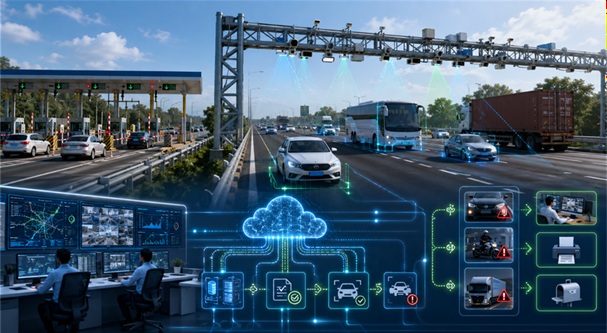
The Core Difference between ETC and MLFF
|
Parameter |
ETC – Electronic Toll Collection |
MLFF – Multi-Lane Free Flow |
|
Physical Infrastructure |
Toll plaza, lane booths, boom barriers |
Overhead gantry, no barrier, no booth |
|
Vehicle Movement |
Vehicles slow down and pass through dedicated lanes |
Vehicles pass at highway speed without stopping |
|
Typical Speed |
Around 10–30 km/h at toll plaza |
Highway speed, depending on corridor design |
|
Core Technology |
FASTag/RFID-based toll collection |
RFID, ANPR, video analytics, backend billing, and enforcement integration |
|
Additional Detection Support |
Usually not required |
LiDAR/Radar-based detection may be integrated as per project requirement |
|
Congestion |
Reduced compared to cash tolling, but still present |
Significantly reduced or eliminated at the tolling point |
|
Enforcement |
Barrier-based control or manual intervention |
ANPR-based violation detection and recovery workflow |
|
Best Suitable For |
Existing toll plazas being digitized |
New expressways, high-traffic corridors, and congestion prone toll plazas |
Why This Difference Matters for Concessionaires
For BOT, HAM, highway operators, and concessionaires, ETC vs MLFF is not only a technology decision. It affects the complete tolling model, including infrastructure planning, traffic management, revenue protection, and enforcement.
ETC is suitable where an existing toll plaza is already available and the main requirement is to digitize toll collection through FASTag/RFID. In this model, vehicles still pass through toll lanes and may need to slow down.
MLFF is suitable where congestion, queue time, and lane-based tolling are major concerns. It removes the need for physical barriers and allows vehicles to move freely through the tolling point. This improves travel time, traffic flow, and user experience.
What MLFF Requires That ETC Does Not
MLFF is a barrier-free tolling system, so enforcement cannot depend on a boom barrier. Instead, it requires accurate data capture, backend validation, and automated violation management.
A proper MLFF deployment depends on:
- Accurate FASTag/RFID reading at highway speed
- High-speed ANPR cameras for vehicle number plate recognition
- Video analytics for vehicle identification and traffic validation
- Backend integration between RFID, ANPR, sensor data, and billing engine
- Violation detection workflow for vehicles without valid FASTag or unmatched transactions
- Recovery and enforcement mechanism for non-compliant vehicles
- Real-time monitoring dashboard and reporting system
- LiDAR/Radar-based detection, wherever required as per project design, for speed tracking, vehicle presence detection, lane-level validation, and classification support
Role of LiDAR/Radar in MLFF
In MLFF projects, vehicles do not stop at the tolling point. Therefore, accurate vehicle detection and validation become very important.
LiDAR/Radar sensors may be integrated as per project requirement to support:
- Vehicle presence detection
- Speed tracking
- Lane-level validation
- Vehicle classification support
- Cross-verification with RFID and ANPR data
- Reduction of missed or duplicate transactions
- Improved enforcement accuracy
RFID and ANPR help identify the vehicle, while LiDAR/Radar can support movement validation, speed tracking, lane positioning, and detection accuracy in free-flow traffic conditions.
Benefits of MLFF for Concessionaires
|
Benefit |
Impact |
|
Reduced Congestion |
Vehicles move without stopping, reducing queue formation |
|
Better User Experience |
Smooth and barrier-free movement for highway users |
|
Improved Tolling Efficiency |
Automated identification, billing, and validation |
|
Lower Manual Intervention |
Less dependency on booth-level manual operations |
|
Better Enforcement |
ANPR-based violation tracking and recovery workflow |
|
Higher Throughput |
More vehicles can pass through the tolling point in less time |
|
Data-Driven Operations |
Better reporting, monitoring, and transaction validation |
When to Choose ETC and When to Choose MLFF
|
Scenario |
Recommended System |
|
Existing toll plaza with moderate traffic |
ETC |
|
Existing plaza with heavy congestion |
MLFF |
|
New expressway or greenfield corridor |
MLFF |
|
Low-cost digital tolling upgrade |
ETC |
|
Need barrier-free vehicle movement |
MLFF |
|
Need advanced enforcement and automated recovery |
MLFF |
GreenTech ITS MLFF Solution
GreenTech ITS offers an integrated MLFF solution combining RFID, ANPR, video analytics, backend billing, violation management, and LiDAR/Radar-based detection wherever required as per project design.
The solution is designed to support accurate vehicle identification, automated toll transaction processing, lane-level validation, and enforcement for non-compliant vehicles in barrier-free tolling environments.
GreenTech ITS can support concessionaires with end-to-end MLFF implementation, including:
- System design and architecture
- RFID reader and antenna integration
- ANPR camera integration
- Video analytics integration
- LiDAR/Radar sensor integration, wherever required
- Backend billing integration
- Violation detection and recovery workflow
- Control room and dashboard integration
- Installation, testing, and commissioning
- Operation and maintenance support
FAQ
Q1. Does MLFF replace FASTag?
No. MLFF does not replace FASTag. FASTag/RFID remains one of the primary payment identifiers. MLFF adds ANPR, video analytics, backend billing, and enforcement workflows to enable barrier-free tolling.
Q2. Can existing toll plazas be converted into MLFF?
Yes. Existing toll plazas can be converted into MLFF, but it usually requires additional gantry infrastructure, ANPR cameras, RFID readers, backend integration, and violation management workflows. LiDAR/Radar sensors may also be added depending on the project design.
Q3. What happens if a vehicle without FASTag passes through an MLFF point?
The ANPR camera captures the vehicle number plate. The system flags the vehicle as a violation or unmatched transaction and routes it into the recovery/enforcement workflow instead of physically stopping the vehicle.
Q4. Is MLFF more expensive than ETC?
Yes. MLFF generally requires higher initial investment because it needs gantry infrastructure, ANPR cameras, RFID systems, backend integration, and enforcement systems. However, it provides long-term benefits through reduced congestion, better throughput, improved automation, and lower manual dependency.
Q5. What technologies are required for MLFF implementation?
A typical MLFF system requires FASTag/RFID readers, ANPR cameras, video analytics, backend billing software, violation management system, monitoring dashboard, and integration with enforcement or recovery workflows. LiDAR/Radar sensors may also be used depending on the project design.
Q6. Why is backend integration important in MLFF?
Backend integration is important because MLFF depends on multiple data sources such as RFID, ANPR, video analytics, and sensor data. The backend system validates transactions, matches vehicle records, processes billing, identifies violations, and generates reports for monitoring and enforcement.