

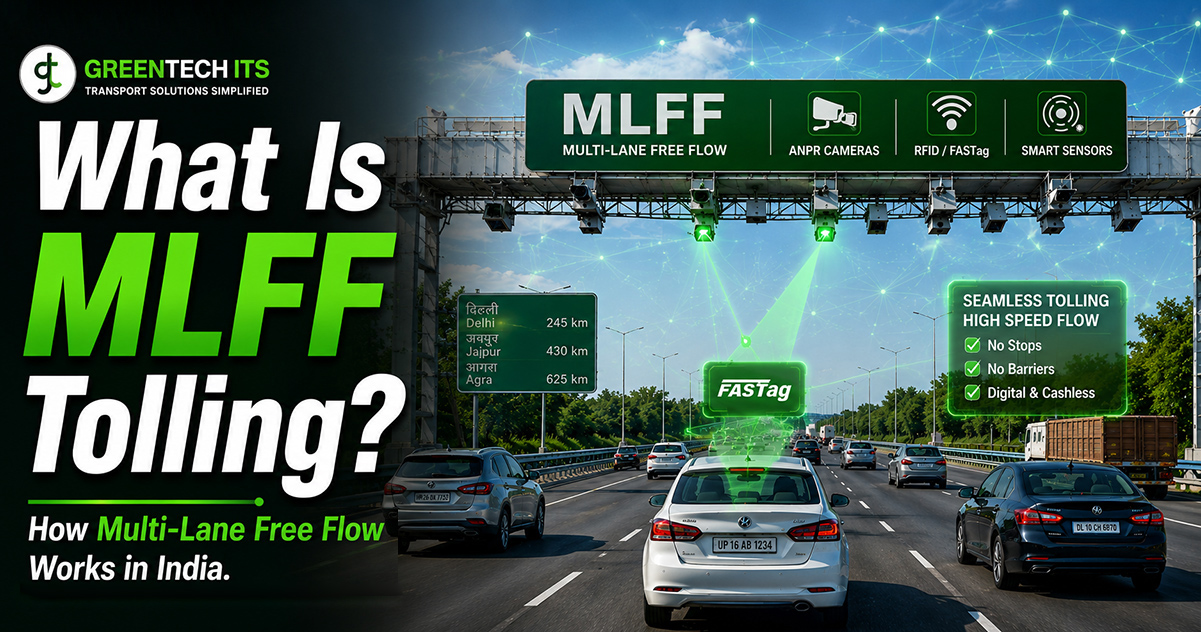
Toll plazas were built to collect revenue. For years, they have also collected something nobody wanted: queues. Even with FASTag bringing wait times down to under a minute at most plazas, vehicles still slow, stop at a barrier, and accelerate again, millions of times a day.
Multiplied across a national highway network, which "stop-and-go" burns fuel, adds travel time, and pumps avoidable emissions into the air around every plaza.
Multi-Lane Free Flow (MLFF) tolling is the engineering answer to that problem. It removes the boom barrier entirely and lets vehicles pay as they drive at full highway speed, in any lane, without stopping.
India crossed a real milestone here in 2026, when the country's first barrier-less MLFF plaza went live at Chorayasi on the Surat-Bharuch stretch of NH-48 in Gujarat. This guide explains what MLFF is.
Let us understand how this technology actually works and why it is essential for those involved in the planning, construction, and operation of highways.
What MLFF tolling actually means
Multi-Lane Free Flow (MLFF) is a barrier-less electronic tolling process by which the vehicle passes a tolling point at highway speed without having to stop, slow for a barrier, or enter any lane designated for congestion pricing.
Instead of physical booths and booms, there's a gantry over the road that can identify every car coming through, classify it, and then collect the toll.
Put in the simplest of terms: you become invisible to the toll plaza. No gate to lift, no lane to select, no transaction, the driver awaits. The road just keeps moving.
This is different from the FASTag lanes most Indian drivers know today. FASTag already made toll payment cashless and fast, but vehicles still funnel into specific lanes and pause at a barrier for the RFID read and gate lift.
MLFF takes the next step: it retains the cashless system while eliminating the need for vehicles to stop.
How MLFF works: the technology behind the gantry
From the driver's seat, MLFF appears quite simple, but in reality, a system of sensors and software is operating with high precision in the blink of an eye. In the current Indian model, this system integrates three key capabilities under a single gantry.
- Automatic Number Plate Recognition (ANPR)
ANPR makes use of high-resolution cameras and number-plate recognition systems tuned for Indian number plates to read every passing vehicle's number plate.
This provides the system with a good identity for every vehicle that passes, which is an important feature when there's no physical barrier to stop someone from not paying. Learn more about ANPR systems.
- FASTag / RFID reading
Payment is still made through the existing framework of FASTag (RFID). These overhead readers receive the FASTag on the windscreen and identify the linkage of the pass with your associated account and automatically deduct the toll.
MLFF does not dismantle the FASTag ecosystem that India spent years building; instead, it operates based on that very foundation. See how it integrates with the comprehensive electronic toll management system and ensures efficient operations. See how this connects to a full electronic toll management system
- Automatic Vehicle Classification (AVC)
The toll rates may vary based on the type of vehicle, such as different charges being levied for a car, bus, and multi-axle truck. The system identifies the type of vehicle traversing through laser and sensor-based classification, meaning that your fee is calculated without a worker needing to verify it. Your AI confirms the charge in real-time by processing ANPR, RFID, and classification data together.
With these three working in harmony, the vehicle identification and payment details, along with the class number, are constantly being read and captured even before the vehicle crosses through the gantry, thus estimating & logging the charge instantly.
What happens when there's no barrier to stop a non-payer?
This is the first question every operator and authority asks, and rightly so. If you remove the boom, you eliminate the most fundamental enforcement tool ever created for tolling.
India's rollout counters it? with a software-and-policy layer, not a physical one. If a vehicle goes through without having any valid/well-loaded FASTag, they get tagged with the registration number captured by the ANPR system.
When this happens, an electronic notice is sent to the registered owner of the vehicle, and they are required to clear the dues within a specified period of time.
If delayed in paying penalties, loading such additional amounts as penalties and late payment, even spanning existing amounts tied to the provision of certain services based on its regulation performance level.
For this to work, one thing has to be near-perfect: the link between a vehicle's registration number and its FASTag must be accurate. That's why NHAI has pushed FASTag-issuing banks to verify and correct registration data. Accurate vehicle-registration mapping is the quiet foundation that the whole barrier-less model stands on.
Why MLFF matters: the outcomes that justify the investment
MLFF is an upgrade, not for convenience. At once, it alters the economics and user experience of tolling for those in charge of highways.
Zero waiting time: Vehicles cross at highway speed, no queue, and idle cycle at plazas.
Fuel and emission savings: Reduced idling and acceleration reduce fuel consumption and emissions around the plaza. Removing stop-and-go tolling could save nearly $200 million a year in fuel.
Throughput: Free-flow corridors function in a manner capable of moving significantly greater vehicles per hour than barrier lanes, and this advantage grows as the volume of traffic increases.
Revenue integrity: Automated identification and charging minimizes manual gaps where leakage occurs.
Improved data: Every pass collects real-time volume, classification, and revenue fuel for planning, audit, and analytics.
In the case of logistics and freight, gains compound: every plaza in a single trip in turn saves time at all of them, leading to greater fleet turnover and lower cost per kilometre.
Where India stands in 2026
The Chorayasi plaza on NH-48 marked India's first live barrier-less MLFF deployment, and it's the template for what comes next.
NHAI has signalled expansion to a set of national highway fee plazas, with tenders awarded for an initial batch and a stated goal of scaling barrier-less tolling across the network through 2026.
Just as significantly, the procurement model is shifting from a bank-centric bidding approach toward an integrated technology-partner model, recognising that MLFF is a systems-integration challenge, not just a payment one.
The movement is the real headline of this industry. For barrier-less tolling, either with or without a vehicle, to live or die in terms of integration has to be perfect: ANPR accuracy, classification reliability for accidents, if not payment reconciliation processes work as one 24/7 system - all weather speeds.
But you're exactly right: that is an ITS engineering problem, and that's what experienced system integrations fall into.
Frequently Asked Questions
What is MLFF tolling in simple terms?
Multi-Lane Free Flow (MLFF) tolling is a type of toll collection system that allows vehicles to pass through toll points at highway speeds with no stops and no barriers.
The gantry has cameras and FASTag readers, as well as a vehicle-classification sensor on top to automatically identify the toll and charge it.
How is MLFF different from FASTag?
FASTag made toll payment cashless, but vehicles still slow down and stop at a barrier in dedicated lanes.
MLFF keeps the FASTag payment backbone but removes the barrier and the stoppage, so vehicles pay while moving at speed in any lane.
What happens if a vehicle passes an MLFF plaza without paying?
Driving through an MLFF toll plaza without paying doesn't mean the toll is missed. The system identifies the vehicle through FASTag and cameras, records the transaction, and the toll amount can be recovered later, along with applicable penalties.
Does MLFF need a special device in my car?
The existing FASTag continues to be used in India's ANPR-and-FASTag-based model, which means no new in-vehicle device is required. The key behind the system works when both the vehicle registration number and FASTag are linked correctly.
Build barrier-free tolling that actually holds up at scale.
MLFF is as good as the integrations that are built on it. About GreenTech ITS is dedicated to designing, deploying, and operating end-to-end intelligent tolling systems in ANPR FASTag/ETC automatic vehicle classification round-the-clock O&M, having 12+ Years of strong experience in the domain with CMMI Level 3 & STQC Certified Delivery.
Planning an MLFF or barrier-less tolling project? [Talk to our experts](/contact-us) about your corridor.